
A few years ago, we finally decided to do something we had been postponing for far too long. You know those plans that always sound like “we’ll do it when we have more time”? This was one of them.
So we stopped waiting.
We packed our backpacks, loaded the offline maps, checked the car one more time, and set off from Bucharest on a two-week Austria road trip. Just my husband and me, our car, a vague idea of where we wanted to go, and that wonderful feeling that comes with knowing you have several days ahead of you with nowhere you absolutely have to be.
What we wanted most wasn’t a trip where we would rush between famous landmarks, take a photo, tick a box and move on. We wanted to experience Austria at a slower pace—to drive through its landscapes, walk through its cities, sit in cafés, notice how people live and simply allow ourselves to be somewhere else for a while.
And Austria turned out to be exactly the kind of place we had hoped for.
There is something incredibly reassuring about this country. Everything seems organized without feeling sterile, peaceful without being boring, and beautiful without constantly trying to impress you. From the moment we crossed into Austria, I remember thinking that this was a place where I could actually imagine living.
Our route took us through Vienna, Graz, Innsbruck and Hallstatt, with plenty of time on the road in between. Each destination had a completely different personality, which is one of the things I loved most about this trip.
Here is how we experienced it.
In This Guide
- Our Austria Road Trip at a Glance
- Hitting the Road: From Bucharest to Austria
- Vienna: Imperial Elegance Without the Rush
- Graz: The Austrian City That Surprised Us
- Innsbruck: When the Alps Become the Main Attraction
- Hallstatt: Beautiful, Dreamlike—and Very Busy
- What Made This Austria Road Trip Special
- Practical Tips for an Austria Road Trip
- Final Thoughts
Our Austria Road Trip at a Glance
Before getting into the details, this was the route we followed:
Bucharest → Hungary → Vienna → Graz → Innsbruck → Hallstatt/Obertraun → Hungary → Bucharest
We spent around two weeks on the road, which gave us enough time to enjoy the destinations without turning the trip into a race.
If you’re planning a similar Austria road trip from Romania, I would strongly recommend allowing yourself this kind of flexibility. Austria isn’t a country I would want to rush through. Some of my favorite memories weren’t actually at the major attractions—they were moments between them: driving through the mountains, stopping for coffee, watching cows in a meadow, or simply wandering around a neighborhood with no particular destination.

Hitting the Road: From Bucharest to Austria
We left Bucharest early in the morning, knowing that the first part of the journey would be mostly about putting kilometers behind us.
Driving from Romania to Austria is a long journey, but one of the things I liked about doing it by car was the gradual transformation of the landscape. You don’t suddenly arrive in a completely different world. Instead, you watch it happen slowly outside the car window.
Our first important stop was after Sibiu (Hermannstadt), where we took a break, checked that everything was in order and prepared for the Hungarian part of the journey.
Road Vignettes and Tolls
For this trip, we needed to take into account the road toll systems in both Hungary and Austria. Hungary uses an electronic vignette system, while Austria requires a motorway vignette for most motorways and expressways.
At the time of our trip, we paid approximately €15 for a 10-day Hungarian e-vignette and €11.50 for a 10-day Austrian vignette. Prices and regulations can change, so if you’re planning your own trip, always check the current official rates before leaving.
Buying the vignettes online in advance made the journey much easier. One less thing to worry about once you’re already tired from driving. And then came Hungary.
The border crossing itself was surprisingly uneventful, and I remember being struck by how quickly the landscape changed as we continued west. The roads were excellent, the scenery became greener, and the closer we got to Austria, the more excited I became.
Then, almost imperceptibly, Austria began. And it was beautiful.
First Impressions of Austria
There are countries where you need a little time to adjust. Austria wasn’t one of them.
The first thing I noticed was the sense of order. The roads were immaculate, the villages looked almost unreal, and everything seemed to work quietly in the background. There was no feeling of chaos or unnecessary noise.
And then there were the mountains.
Coming from Romania, where we are certainly not strangers to beautiful landscapes, I still found the Austrian scenery almost absurdly picturesque. Mountains appeared behind villages, perfectly maintained houses sat beside green fields, and cows grazed in pastures that looked like they belonged on a postcard.
I remember joking about the cows being impossibly clean. How do they do that? But underneath the jokes, there was something else I kept feeling throughout the trip: peace. Austria felt safe, predictable and incredibly comfortable. More than once, I caught myself thinking, “How wonderful would it be to live here?”
And that thought followed me throughout the entire journey.

Vienna: Imperial Elegance Without the Rush
Our first major stop was Vienna, where we spent four nights.
Four nights were enough to get a taste of the city, but honestly, they weren’t enough to know Vienna properly. Looking back, I would happily spend a full week there, especially if the goal were to experience the city rather than simply see its main attractions.
We stayed in Leopoldstadt, close to the Prater. We chose the area partly because accommodation was more affordable than in some of Vienna’s central districts, while still giving us easy access to the main sights.
What to See in Vienna
Schönbrunn Palace
Schönbrunn was one of those places where I immediately understood why it is so famous.
The palace itself is impressive, but what stayed with me most were the gardens. They are enormous, and you could easily spend several hours walking around without realizing how much time has passed.
I loved that the experience wasn’t simply about entering a historic building, looking around and leaving. The entire estate invites you to slow down.
St. Stephen’s Cathedral
Stephansdom is one of those landmarks that photographs don’t quite prepare you for.
Standing in front of it, surrounded by the energy of central Vienna, I found myself noticing all the little architectural details rather than simply thinking, “Okay, I’ve seen it.”
It’s the kind of place where I recommend giving yourself time to stop and actually look.
Belvedere Palace
Belvedere was another highlight, especially because of Gustav Klimt’s The Kiss.
I’m not someone who needs to visit every art museum in every city, but seeing The Kiss in person was still a memorable experience. Even if you’re not particularly passionate about art, the palace and its surroundings make the visit worthwhile.
Prater
In the evening, we headed to the Prater for a completely different side of Vienna.
There was something wonderfully carefree about walking around the amusement park after a day of sightseeing. And no, you definitely don’t need to be twelve years old to enjoy it.
Sometimes the best travel evenings are the ones where you aren’t trying to accomplish anything.
Where We Ate in Vienna
We tried to keep our food choices relatively affordable, because eating out three times a day in Vienna can quickly add up.
Wiener Deewan was one of our favorites. It’s a Pakistani restaurant with a pay-as-you-wish concept, and the food was both delicious and budget-friendly.
We also tried Der Wienerwald, particularly for traditional Austrian food and generous portions. And for something quick, Trzesniewski was perfect for its small traditional sandwiches.
What I Wish We Had Done Differently
If I could go back, I would give Vienna more time.
Four nights were enough to see the highlights, but Vienna is not a city I would recommend experiencing as a checklist. I would rather spend a morning visiting a palace, an afternoon sitting in a café and an evening wandering through a neighborhood than squeeze ten attractions into one day.
That’s probably the biggest lesson I took from this trip: slow travel suited Austria perfectly.

Graz: The Austrian City That Surprised Us
After Vienna, we continued to Graz, and this was where the trip started to feel noticeably slower.
Graz is Austria’s second-largest city, but somehow it didn’t feel like a big city to us. It felt youthful, relaxed and approachable, with colorful streets, historic architecture and a more laid-back atmosphere than Vienna.
We stayed close to the old town in a cozy guesthouse with breakfast included, which turned out to be a great base for exploring on foot.
Things to Do in Graz
Schlossberg and the Clock Tower
The climb up Schlossberg is not particularly difficult, but after walking around the city all day, I definitely felt those steps. Still, the panoramic view from the top made it completely worth it.
The Clock Tower is probably the most recognizable symbol of Graz, and we spent some time around it simply enjoying the view over the city.
One of my favorite memories from Graz is actually quite simple: sitting down with a lemonade and looking out over the rooftops. No major attraction. No carefully planned activity. Just being there.
Kunsthaus Graz
Then there is the Kunsthaus Graz, which looks almost completely out of place among the historic buildings.
The strange blue structure has been compared to everything from a jellyfish to a spaceship, and I loved the contrast. Graz manages to combine its historic identity with contemporary architecture without either one overwhelming the other.
Where We Ate in Graz
For traditional Austrian food, we tried Gösser Bräu, which had exactly the hearty atmosphere and generous dishes we were looking for.
We also visited Aiola Upstairs, particularly for the views.
Why Graz Became One of My Favorites
Graz was probably the city where I felt most relaxed. Vienna is beautiful and sophisticated, but there is a certain energy to it. Graz allowed us to slow down even further.
We wandered through the historic center without a plan, stopped whenever something caught our attention and didn’t feel guilty about “wasting” time. And that’s precisely why I think Graz deserves more attention from travelers.
It isn’t necessarily the city that screams for your attention. It quietly earns it.

Innsbruck: When the Alps Become the Main Attraction
From Graz, we continued west toward Innsbruck. And this was the moment when our Austria road trip became a completely different experience. The drive itself was spectacular.
There were tunnels, valleys, turquoise rivers and mountains rising dramatically on both sides of the road. Even when we weren’t actively sightseeing, I felt like I was sightseeing.
There are road trips where you spend the entire journey waiting to reach the next destination. This wasn’t one of them.
Where We Stayed in Innsbruck
We stayed in a historic hotel around 1.2 km from the city center. The location was convenient enough to walk into town, but what I remember most were the mornings.
The air was crisp, there was that wonderful smell of wet wood, and somewhere in the distance you could hear cowbells. It felt almost surreal.
The Best Things to Do in Innsbruck
Nordkette
If you only have time for one major experience in Innsbruck, I would make it Nordkette.
The cable car takes you rapidly from the city into the mountains, and the view from above is difficult to describe without sounding overly dramatic.
You start in an urban environment and, seemingly minutes later, you’re surrounded by the Alps. That contrast is what makes Innsbruck so special.
Golden Roof
Back in the historic center, the Golden Roof is one of Innsbruck’s most recognizable landmarks.
It’s relatively small compared with some of the grand attractions elsewhere in Austria, but it is impossible to miss while exploring the old town.
Alpenzoo
We also visited Alpenzoo, which made for a nice change of pace after so much sightseeing.
It’s not a huge zoo, but it focuses on Alpine wildlife, making it particularly appropriate for the destination.
Where We Ate in Innsbruck
For traditional Austrian food, we visited Stiftskeller, which had the kind of atmosphere I had hoped for when imagining an Austrian dinner.
For breakfast, Breakfast Club offered generous portions and affordable options, which was exactly what we needed before another day of exploring.
Why Innsbruck Stayed With Me
I think the mountains are what make Innsbruck unforgettable. They are simply there, all the time.
You walk down an ordinary street and see an enormous mountain wall at the end of it. Then, you have coffee, and the Alps are still there. Next, you drive to the supermarket, and there they are again.
It changes the way a city feels. Innsbruck managed to give us the organization and comfort we had already loved about Austria while putting us directly next to something much wilder and more powerful.

Hallstatt: Beautiful, Dreamlike—and Very Busy
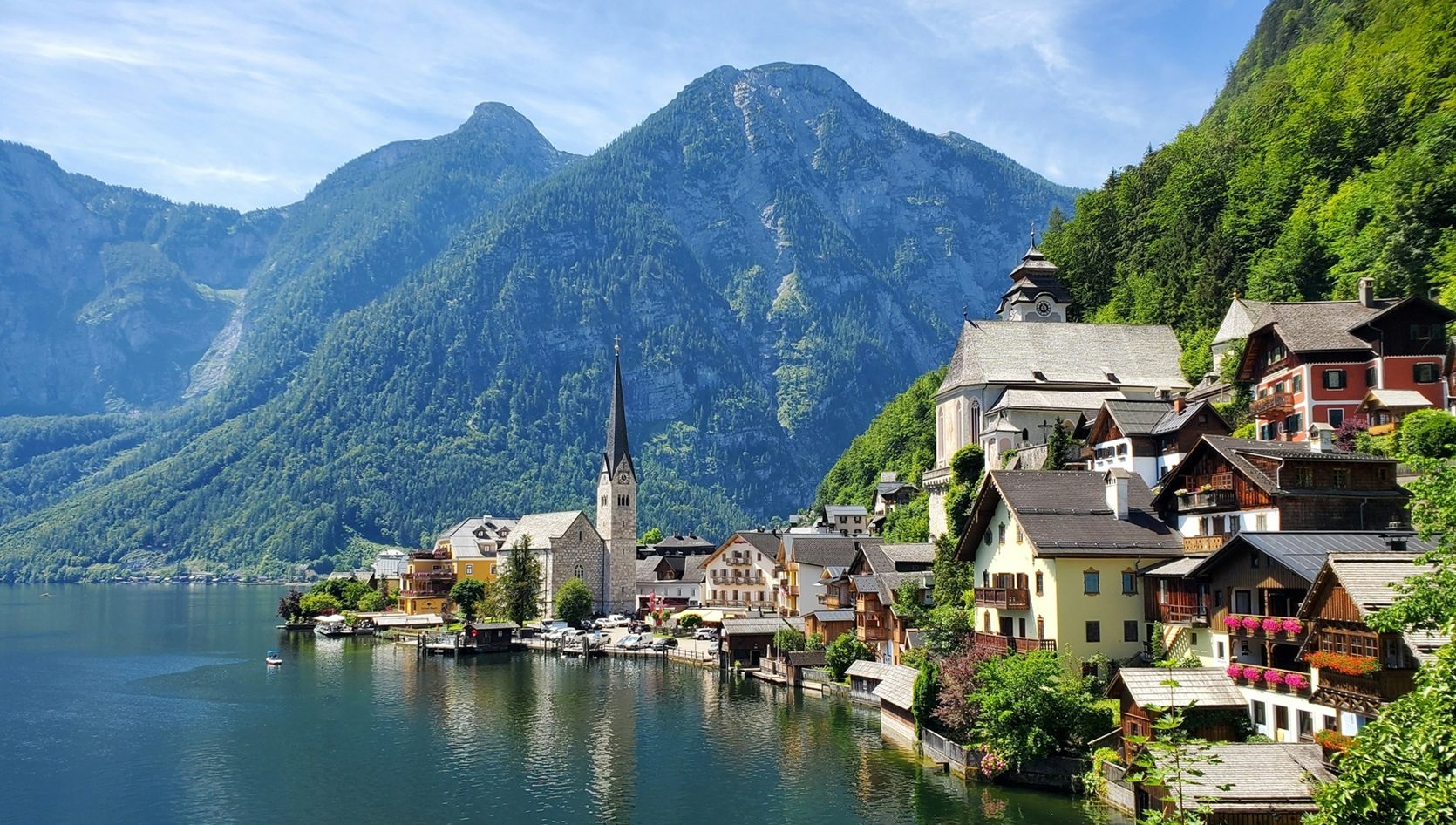
Our final major stop was Hallstatt. And yes, Hallstatt is every bit as beautiful as you’ve seen in photographs. It’s also touristy, hence crowded. And depending on when you visit, it can be crowded enough to make the fairytale atmosphere slightly harder to appreciate.
But even knowing that beforehand, I still found it incredibly beautiful.
Why We Stayed in Obertraun Instead
Rather than staying directly in Hallstatt, we booked accommodation in Obertraun, around ten minutes away by car. Looking back, this was one of the best decisions we made during the entire trip.
Hallstatt accommodation can be expensive, and staying nearby gave us a quieter base while keeping the village easily accessible. If you’re planning your own trip, I would definitely consider looking at nearby towns rather than automatically booking inside Hallstatt itself.
What We Did in Hallstatt
We walked along the lake around sunset, when the light made everything feel even more unreal.
We visited the Hallstatt Skywalk, which offers spectacular views over the village and lake, and then wandered through the old town, stopping for a warm soup and dessert. But my favorite Hallstatt memory wasn’t actually a landmark.
At one point, we simply sat on a bench beside the lake. We didn’t talk much. We just watched the water, the mountains and the village around us. After days of driving and sightseeing, it was one of those rare moments when absolutely nothing needed to happen.
And somehow, that’s the moment I remember most clearly.
Where We Ate in Hallstatt
We had traditional Austrian food at Gasthof Simony, while Seecafé was a lovely place to stop for coffee and dessert with a lake view.
As with most tourist destinations, prices around Hallstatt can be higher than elsewhere, so it’s worth keeping that in mind when budgeting.
What Made This Austria Road Trip Special
Looking back, I don’t think the four destinations were the only reason this trip stayed with me. It was the feeling of moving through Austria slowly.
One day we were walking through Vienna’s imperial streets. A couple of days later, we were drinking lemonade in Graz. Then we were surrounded by the Alps in Innsbruck, and finally sitting quietly beside a lake in Hallstatt.
The contrast made the journey feel much richer than simply visiting four beautiful places. And there was something else I kept noticing throughout the entire trip: how easy Austria felt.
There was a pervasive sense of safety and organization. Public spaces were clean, roads were well maintained, and everything seemed to function without demanding much attention from you. I know that sounds like a small thing. But when you’re traveling by car for two weeks, those small things become important.

Practical Tips for an Austria Road Trip
Is Austria Expensive?
Austria isn’t one of Europe’s cheapest destinations, but I wouldn’t describe it as inaccessible either.
Accommodation in Vienna, Innsbruck and Hallstatt can be expensive, particularly during peak season. However, staying slightly outside the most touristy areas can make a significant difference.
Food is similarly flexible. You can spend a lot at a restaurant in a major tourist area, but there are also affordable cafés, bakeries and casual restaurants.
For us, choosing reasonably priced accommodation, mixing restaurant meals with quick lunches and avoiding unnecessarily expensive tourist options helped keep the trip manageable.
Is Austria Easy to Explore by Car?
Absolutely. For this particular itinerary, having a car gave us much more freedom than relying exclusively on trains. The roads were excellent and navigation was straightforward. The main things to plan for are motorway vignettes, parking and possible additional tolls for certain tunnels or mountain routes.
The biggest advantage, however, was flexibility. We could stop when we wanted, change our plans and enjoy the scenery rather than treating the journey between destinations as simply transportation.
How Many Days Do You Need for This Austria Road Trip?
For our route, two weeks felt almost perfect. It gave us enough time to spend several nights in each city without constantly packing and unpacking.
If you only have seven days, I would reduce the number of destinations rather than trying to reproduce the entire route at a faster pace. Austria rewards slow travel. The country is beautiful enough that some of your best memories may come from the hours you didn’t plan.

Our Austria Road Trip: Final Thoughts
Our two-week journey through Austria ended up being much more than a sightseeing trip. It was a pause. A genuine pause from routines, deadlines and the feeling that you constantly need to be somewhere else.
Vienna gave us elegance and history. Graz surprised us with its relaxed personality. Innsbruck completely stole our hearts with its mountains, while Hallstatt gave us those quiet, almost cinematic moments that stay with you long after you’ve returned home.
And somewhere between all of those places, I started thinking seriously about what it would actually feel like to live in Austria. I still have that thought sometimes.
Maybe it’s the mountains, or perhaps it’s the order. Maybe it’s simply the feeling of safety and calm that followed us everywhere. Or possibly it’s because Austria somehow manages to make everyday life look beautiful. Either way, I’m glad we finally stopped saying “we’ll do it when we have time.”
Because sometimes you don’t suddenly find the time. You make it. And if you’re considering an Austria road trip from Romania, I can honestly say this: don’t wait for the perfect moment. Pack the car, choose a route that gives you room to breathe, and leave some empty space in your itinerary.
You might find that the moments you didn’t plan become the ones you remember most. Two weeks. Four cities. One unforgettable road trip. And a country we still haven’t stopped dreaming about.